Automated Logic ACxelerate v3.0 is an automated commissioning tool designed as an add-on for the WebCTRL v9 or higher building automation system. It streamlines variable air volume (VAV) commissioning by automating equipment discovery and functional testing, reducing the manual effort required to verify terminal unit operation.
Designed to support single-duct, dual-duct, and fan-powered VAV terminal units in both series and parallel configurations, ACxelerate automatically discovers supported VAV boxes and associated air handling units (AHUs) and rooftop units (RTUs). It automates functional testing of dampers and reheat valves to help verify proper equipment operation.
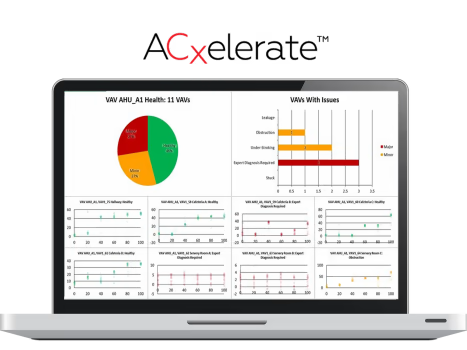
Version 3.0 introduces expanded testing for fan-powered VAV boxes, access to historical test results, improved equipment discovery, and a streamlined user interface. The tool generates comprehensive, exportable reports documenting system health, operational performance, and detected faults.
Automated fault analysis categorizes issues by severity, helping commissioning teams, building owners, and facility managers identify problems, prioritize maintenance, and verify system performance over time.
By reducing commissioning timelines from days or weeks to hours, ACxelerate helps streamline project handovers, support ongoing performance verification, and improve building system reliability.
ACxelerate v3.0 is available as a subscription for the WebCTRL building automation system.
Key Features & Benefits
Features:
- • Automated commissioning add-on for the WebCTRL v9 or higher building automation system.
- • Automatically discovers supported VAV boxes and associated AHU/RTU equipment.
- • Supports single-duct and dual-duct VAV terminal units.
- • Supports series and parallel fan-powered VAV terminal units.
- • Automates functional testing of VAV dampers and reheat valves.
- • Expanded automated testing for fan-powered VAV boxes in version 3.0.
- • Access to historical test results with the ability to view and rerun previous tests.
- • Improved equipment discovery for associated HVAC systems.
- • Streamlined user interface for simplified setup and test execution.
- • Generates comprehensive, exportable system health and commissioning reports.
- • Documents operational performance and maintains historical test records.
- • Automated fault detection, analysis, and categorization.
- • Dashboard views highlight areas of concern and identify issues requiring follow-up.
- • Fault classifications include normal, minor faults, critical faults, and inconclusive results.
- • Identifies issues such as starving VAV boxes, over-stroking, maximum and minimum airflow errors, leakage, stuck equipment, obstructions, sensor faults, reversed operation, and insufficient actuation range.
- • Supports ongoing performance verification after initial commissioning.
- • Helps commissioning teams reduce manual on-site testing effort and accelerate project handovers.
Benefits:
- • Faster Commissioning: Automates equipment discovery and functional testing, helping reduce commissioning timelines from days or weeks to hours.
- • Reduced Manual Effort: Streamlines on-site testing of supported VAV terminal units, dampers, and reheat valves.
- • Improved Fault Detection: Automatically identifies and categorizes equipment faults, helping teams prioritize corrective actions.
- • Comprehensive Reporting: Generates exportable health reports that document system status, fault locations, and test results.
- • Simplified Performance Verification: Provides historical test results and the ability to rerun tests to validate equipment operation.
- • Ongoing System Performance: Helps facility managers verify that VAV system performance is maintained after initial commissioning.
- • Streamlined Project Handover: Helps commissioning teams and system integrators complete testing more efficiently and document system readiness.
- • Improved Building Performance: Identifies operational issues that may affect occupant comfort, airflow control, and HVAC system performance.
- • Better Maintenance Prioritization: Fault severity classifications help facility teams focus attention on equipment requiring investigation or repair.